# moonmix
A pavucontrol-style volume control for modern Linux audio (PipeWire with
WirePlumber), written in [MoonBit](https://www.moonbitlang.com) with a GTK4
GUI.
moonmix talks to the audio stack **through its libraries**: libwireplumber-0.5
on top of libpipewire-0.3. It never runs `wpctl`, `pactl`, `pw-cli`,
`pw-dump` or any other CLI tool.
| Playback | Output Devices |
| --- | --- |
| 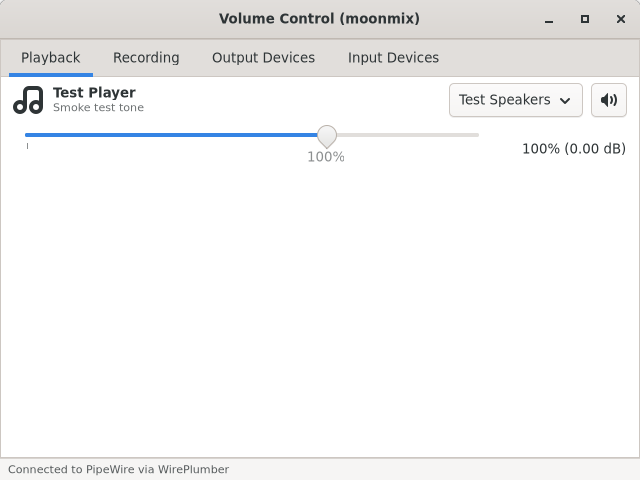 | 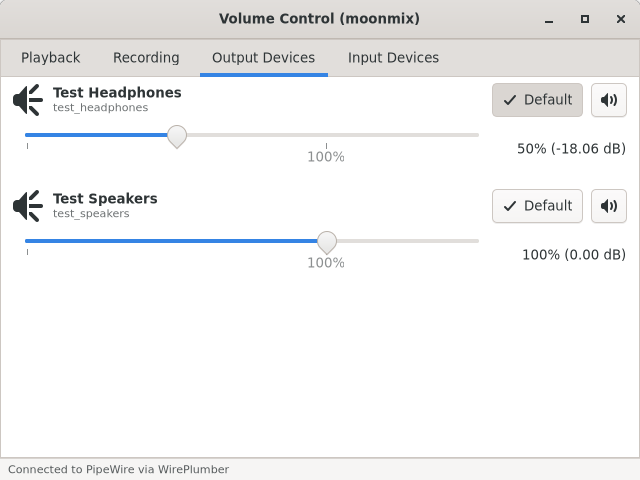 |
| **Recording** | **Input Devices** |
| 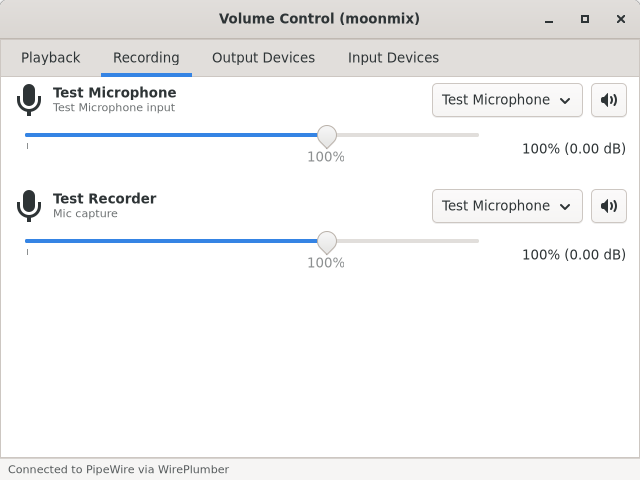 | 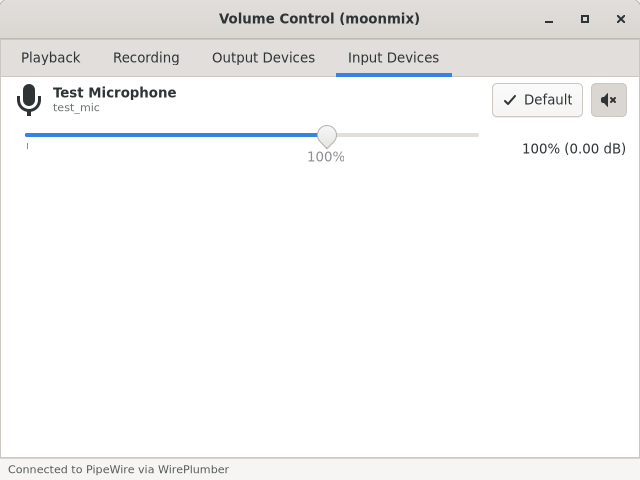 |
*(Rendered headlessly against a private PipeWire with null sinks; see
[Testing](#testing).)*
## Features (v1)
- **Playback**: every application stream, with a volume slider, mute and the
output device it plays to (choose another to move it).
- **Recording**: capture streams, same controls, input device selector.
- **Output Devices** / **Input Devices**: sinks and sources with volume, mute
and a *Default* toggle that shows and sets the default device.
- Volumes in percent exactly like pavucontrol/wpctl: the cubic mapping of
PipeWire's linear `channelVolumes`, up to 150%, with the dB value next to
it. One slider moves all channels, keeping the channel balance.
- Live updates: devices and streams appearing, disappearing or changing
elsewhere (another mixer, keyboard volume keys, a new Bluetooth headset)
show up immediately.
Not yet included: the Configuration tab (card profiles), per-channel
sliders, peak meters, monitor sources in Input Devices.
## Architecture
```
cmd/moonmix GUI: builds tabs, reconciles widgets with view rows
cmd/moonmix-probe headless CLI over the same stack (smoke tests, debugging)
model/ pure MoonBit: volume curve, state reducer, view model
wp/ WirePlumber binding: wp_stub.c + wp.mbt
gtk/ minimal hand-written GTK4 binding: gtk_stub.c + gtk.mbt
tools/pkg-cc C compiler wrapper that adds pkg-config flags
```
```mermaid
flowchart LR
PW[(PipeWire)] <--> WP[libwireplumber
mixer-api, default-nodes-api,
object manager]
WP -- "(kind, id) events" --> WPB[wp package]
WPB -- "model.Event" --> S[model.State.apply]
S --> V[model.rows / diff_rows]
V --> G[GTK4 widgets]
G -- "set volume / mute / default / move" --> WPB
```
- **WirePlumber, not raw PipeWire.** The C layer (`wp/wp_stub.c`, about 460
lines) does what `wpctl` does internally. A `WpObjectManager` watches audio
nodes, links and the `default` metadata. The **mixer-api** plugin reads and
writes volume and mute; for hardware sinks it goes through the device's
route, which is where pavucontrol's numbers live. The **default-nodes-api**
plugin reads and sets the default sink and source. To move a stream,
moonmix sets `target.object` in the `default` metadata, as pipewire-pulse
does for pavucontrol. The C layer sends MoonBit one callback per change,
`(kind, id)`. MoonBit then pulls node properties and volumes through small
accessor functions, so no C structs cross the FFI boundary.
- **One main loop.** WirePlumber and GTK4 both run on the default GLib main
context, so events arrive on the GUI thread with no locking or polling.
- **Pure core.** Everything else is plain MoonBit in `model/`: the cubic and
linear conversions, dB formatting, linked-slider scaling, the reducer that
applies node, link and default events, the per-tab rows, and the row diff
the GUI applies. `moon test` covers it on any target.
- **GTK binding.** It is hand-written and minimal. Each widget gets a tag
when it is created, and signals come back as `(tag, value)` through a
single callback. While MoonBit updates widgets from the model, signals are
suppressed so model updates never echo back into PipeWire. For a short
time after the user moves a slider, remote updates to that slider are
ignored so it doesn't jump while being dragged.
## Building
### Dependencies
You need MoonBit (`curl -fsSL https://cli.moonbitlang.com/install/unix.sh | bash`,
then add `~/.moon/bin` to `PATH`), a C compiler, `pkg-config` and the
development files:
| Distro | Packages |
| --- | --- |
| Arch | `pipewire wireplumber gtk4 pkgconf base-devel` |
| Debian 13+ / Ubuntu 24.04+ | `build-essential pkg-config libpipewire-0.3-dev libwireplumber-0.5-dev libgtk-4-dev` |
| Fedora (untested) | `gcc pkgconf-pkg-config pipewire-devel wireplumber-devel gtk4-devel` |
You need WirePlumber **0.5** and GTK **4.12** or newer. Debian 11 and 12
ship WirePlumber 0.4, which is not supported.
### Build and run
```sh
moon build --target native --release
./_build/native/release/build/cmd/moonmix/moonmix.exe
```
To install it for your user:
```sh
install -Dm755 _build/native/release/build/cmd/moonmix/moonmix.exe ~/.local/bin/moonmix
install -Dm644 data/org.latha.moonmix.desktop ~/.local/share/applications/org.latha.moonmix.desktop
```
Pkg-config flags: moon does not expand `$(pkg-config ...)` in `moon.pkg`
link options. Instead, the packages point `link.native.stub-cc` and `cc` at
`tools/pkg-cc`, a wrapper that adds
`pkg-config --cflags --libs libpipewire-0.3 wireplumber-0.5 gtk4`. moon
derives the archiver name from the compiler name, so `tools/pkg-ar` is a
passthrough to `ar`. Set `MOONMIX_CC` or `MOONMIX_AR` to use another
compiler or archiver.
### Headless probe
`moonmix-probe` uses the same binding and model without a GUI:
```sh
P=./_build/native/debug/build/cmd/moonmix-probe/moonmix-probe.exe
$P # print what every tab shows
$P volume alsa_output.pci-0000_00_1f.3.analog-stereo 40
$P mute 57 1 # node id or node.name
$P default bluez_output.XX_XX.1
$P move
```
## Testing
```sh
moon test --target wasm-gc # pure model tests, no libraries needed
moon check --target native # type-check everything
tools/smoke-test.sh /tmp/shot # needs pipewire, wireplumber, pw-cat, gtk4-broadwayd
```
`tools/smoke-test.sh` starts a private PipeWire and WirePlumber in a temp
`XDG_RUNTIME_DIR`. The instance has two null sinks, a loopback virtual
microphone, and one playback and one capture stream created with `pw-cat`; the CLI is used only
by the test harness. The script runs every probe action and checks its effect,
then starts the GUI under GTK's broadway backend. With `MOONMIX_SCREENSHOT`
set, the GUI renders each tab offscreen to a PNG and exits.
CI (`.gitea/workflows/ci.yaml`) runs the pure checks on the default runner.
It runs the native build and the smoke test in a `debian:trixie` container,
because bullseye has no WirePlumber 0.5.
## Releases
Versioning uses [sweet](.sweet.yml): add a change note with `sweet change`
and prepare releases with `sweet bump`. The version lives in `moon.mod` (the
`// sweet-version` line).